

Tree of Life Journey: January 2026
From Steve Jungkeit
Senior Minister
The First Congregational Church of Old Lyme, Conn.
A small delegation of seven travelers has recently returned from a visit to Palestine. It was a powerful and moving journey, our first since the genocide in Gaza. We were filled with questions, not a little apprehension, a desire to see old friends, and to see for ourselves something of what had happened over the past several years. Ultimately, we found a people whose courage and resilience – to say nothing of their hospitality and care – were intact, and strong as ever. But though we could not see it (nobody in Israel, to say nothing of the West Bank, is allowed to see it), the destruction of Gaza hung in the air like a cloud, dreadful and unavoidable.
We started as a group of ten – seven Christians, and three Muslims. We were reduced to seven – six Christians and one Muslim. First, one of our trip leaders, flying to meet us from Mexico, was questioned by US Customs and Border Patrol agents about her work with a human rights organization. She had her phone and laptop confiscated. That organization strongly advised her not to attempt to enter Israel. Then, another of our leaders was denied entry to Israel for reasons we don’t know. Perhaps it had to do with her public advocacy for Palestine. Perhaps it had to do with her visits to a neighboring country, the place of her birth. We simply don’t know. Because of that denial, neither she nor her husband were able to visit Palestine. And so ten became seven.

With TOL Friends
Our goal was to reestablish contact with the friends and partners that Tree of Life has nurtured over the years, some of whom we have been in relationship with for nearly twenty years now. We wished to assure them that they are not forgotten. We wished to convey our emotional and spiritual support – in addition to our financial and material support as well. We wished to learn what they were going through, and perhaps to carry some of their wisdom home, as we face our own nightmares. If Israel represents the avant-garde of a form of authoritarian state terror, the people of Palestine represent the avant-garde of the opposite reality – an advanced lesson in how to uphold one’s own humanity, as well as that of others, under unimaginable pressure.
Throughout our journey we remained predominantly in the West Bank and East Jerusalem. Not once, never, did we feel that we were at risk or in any kind of danger. One day, however, we passed through Tel Aviv, on our way to a meeting with Gideon Levy, a prominent Israeli journalist who has documented the slaughter in Gaza. His is a lonely and prophetic voice. Tel Aviv looked as though it could have been Malibu, or Miami Beach. You couldn’t have guessed that the equivalent of six nuclear warheads had been dropped a mere thirty miles away. No one wants to know, Levy told us, though of course, it’s impossible not to know.

With Bedouins and Amal Abu Al Kho
On another day, we journeyed to the Negev to visit our Bedouin friends. They too exist thirty miles from Gaza, but they do not live in denial. They were haunted by all they had heard over the past two and a half years (“a screaming comes across the sky,” as Thomas Pynchon memorably put it). They shared how they had been caught in the cross fire of missiles, and of how they sprang into action in order to care for the wounded, and those whose homes had been damaged. They showed us where Bedouin villages were being razed in preparation for the construction of Israeli settlements. Unlike those on the beaches of Tel Aviv, our Bedouin friends know full well what is happening, and they worked with care and diligence to meet the needs of those around them.
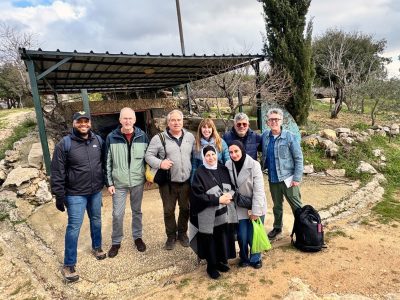
At Tent of Nations
In the West Bank, we visited friends in Beit Sahour, in Ramallah, and at the Tent of Nations. We were welcomed generously. We learned that 150,000 jobs have been lost in the West Bank, because Palestinians are now prevented from crossing into Israel for work. We learned that agricultural labor has been squeezed, because farmers have been cut off from their lands and crops. We learned that tourism had been decimated (70% of the economy in the Bethlehem region is dependent upon tourism). We learned that municipalities were cut off from one another, turning each of them into open air prisons. And we learned that there is an ongoing dread that what happened in Gaza will be visited upon the people of the West Bank. Indeed, the IDF has an increased presence in the West Bank, and its soldiers have been hardened in Gaza.

Arab Womens Union
In a crisis, look for the helpers. Those are the famous words of Fred Rogers after 9/11, but they apply well to Palestine too (to say nothing of our own unfolding crisis in the US). One of the most moving visits we made was in the town of Beit Sahour, to the Arab Women’s Union, a place where local women are doing incredible work to care for their community. In one wing, a group of mentally disabled individuals is offered care – there are women there who are helping them to learn weaving and papermaking and other arts. In another part of the facility, there is a kitchen, where vegetables received from local farms are cleaned and cut and cooked for people in the community. In another area, there is a daycare, filled with children whose parents are trying to earn a wage that is ever more elusive in the West Bank. The individuals who show up at the Arab Women’s Union are saving and upholding the world through ordinary acts of care. They’re living through a crisis, but they’re showing the rest of us how to exist under such conditions – with unwavering decency and compassion.

Khalil Alamour in his Bedouin tent
We saw that care demonstrated everywhere in Palestine, and it moved us to tears – in a school in Beit Sahour, on a hilltop olive farm that refuses to dehumanize those who dehumanize them, with Mazin Qumsiyeh at the Natural History Museum, in a basketball league for young people, at the al-Rowwad Cultural Center in the Aida refugee camp, in a clinic that treated two of our ailing travelers. Despite the awful reality of Gaza, despite the painful realities throughout the West Bank, our visit to Palestine was not depressing or dispiriting. Among all those we visited, we found a familiar and practiced form of resistance to all forms of nihilism and despair. We experienced it as a gift.
Our responsibility, in turn, is to continue to tell the story. To continue to agitate for change here in the United States, which holds all the levers of power in this onslaught against the people of Palestine. Indeed, one person shared that the most hopeful signs he had seen in decades were emerging from the US, where a younger generation of political leaders have begun to push back on Zionist policies. The responsibility to share what we saw, and to do what is in our power to shift these inhumane policies, is something that our travelers now carry in their hearts.
To conclude, here is a quote from Rebecca Solnit, from her book Hope in the Dark: “Hope is not a lottery ticket you can sit on the sofa and clutch, feeling lucky. It is an axe you break down doors with in an emergency. Hope should shove you out the door, because it will take everything you have to steer the future away from endless war, from the annihilation of the earth’s treasures and the grinding down of the poor and marginal… To hope is to give yourself to the future – and that commitment to the future is what makes the present inhabitable.”
It can be hard to practice that kind of hope. And yet against all odds, that’s something of what we found in Palestine – a demonstration of humanity, issued from the center of a cataclysm, when much of the world seems to have forgotten what that means.
As for Tree of Life, we can hope that this will mark a return to our regular visits to Palestine. Our friends are eager to receive us again.
Top photo: Fakhri Abu Diab with Silwan home in ruins
